
Special thanks to Bill Germuga, General Manager of St. Louis Screw & Bolt, for providing his expertise for this piece.
If you work with structural steel, you’ve probably heard the terms A325, A490, F1852, and F2280. Today, these bolt specifications fall under one standard: ASTM F3125.
But what exactly is ASTM F3125, what changed when it replaced the older specifications, and what does it mean for structural bolting in the field?
Here’s what you need to know.
Key Takeaways
- ASTM F3125 is the consolidated specification for high-strength structural bolts and assemblies. It brought six previous structural bolt specifications under one standard, including A325, A325M, A490, A490M, F1852, and F2280.
- The standard covers two main strength grades: 120 KSI, equivalent to legacy A325 and F1852, and 150 KSI, equivalent to legacy A490 and F2280.
- Fasteners under the ASTM F3125 specification are available as heavy hex structural bolts and tension control (TC) bolts, along with Type 1 and Type 3 material classifications.
- The standard introduced updated marking, testing, quality control, and material requirements to create a more comprehensive specification for structural fasteners.
- A key update introduced with F3125 is a uniform strength requirement across all bolt diameters from ½” to 1½”, replacing the prior tiered requirements for larger bolts.
ASTM F3125 at a Glance
ASTM F3125 is the standard specification for high-strength structural bolts and assemblies used in applications such as buildings, bridges, industrial facilities, transportation infrastructure, and other structural steel projects.
The specification brought several previously separate structural bolt specifications together under one standard:
| Previous Specs | Min Strength, Tensile | Type | Style |
| A325 | 120 ksi | 1 or 3 | Heavy Hex Head |
| F1852 | 120 ksi | 1 or 3 | Twist-Off/TC |
| A490 | 150 ksi | 1 or 3 | Heavy Hex Head |
| F2280 | 150 ksi | 1 or 3 | Twist-Off/TC |
The familiar bolt types did not disappear. Instead, ASTM F3125 provides a more unified system for classifying and specifying these high-strength structural fasteners.
What Is ASTM F3125?
ASTM F3125 is a comprehensive specification for high-strength structural bolts used in construction and structural applications.
The specification was developed by the American Society for Testing and Materials (ASTM) to merge and expand six previously separate specifications: A325, A325M, A490, A490M, F1852 and F2280. By consolidating these specifications, ASTM F3125 provides more consistent guideline for requirements related to the manufacturing, testing, identification, and use of structural bolts.
These fasteners are commonly used to connect structural steel components in:
- Buildings and skyscrapers
- Bridges
- Oil and gas facilities
- Transportation infrastructure
- Other large-scale industrial projects
ASTM F3125 Bolt Types
ASTM F3125 covers several types of high-strength structural fasteners. Two of the most common you’ll encounter in structural steel construction are heavy hex structural bolts and twist-off, or tension control (TC), bolts. These structural bolts are classified into two main strength grades: 120 KSI and 150 KSI.
Heavy Hex Bolts
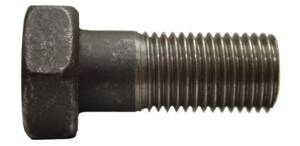
Fully tensioned structural heavy hex bolts feature larger, thicker heads compared to standard hex bolts, providing increased bearing surface and improved load distribution in steel joints.
Tension Control Bolts
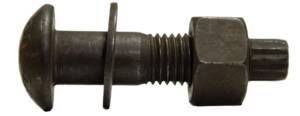
Tension control bolts, also known as twist-off or TC bolts, are supplied as a matched assembly consisting of a bolt, nut, and washer. They are designed with a splined end that shears off when the required tension is achieved, providing a visual indication that the bolt has been properly installed. This system simplifies the installation process and provides a visual indication that the bolt has been properly tightened.
Type 1 Bolts
Type 1 bolts are produced from carbon or alloy steel and are commonly used for general structural applications. They are available in both 120 KSI and 150 KSI grades and may be supplied with different approved finishes, including plain (uncoated), mechanically galvanized, or hot-dip galvanized. The versatility in their finish options allows engineers to choose the most appropriate bolt for their specific environmental conditions and project requirements.
Type 3 Bolts
Type 3 bolts are made from weathering steel offering greater corrosion resistance compared to standard carbon steel. Their material composition allows these bolts to form a protective rust layer when exposed to the elements, preventing further corrosion. Type 3 fasteners can be used in outdoor applications exposed to harsh weather conditions and are also available in 120 KSI and 150 KSI grades.
Where Did ASTM F3125 Come From?
ASTM F3125 represents a merging of six previously separate standards: A325, A325M, A490, A490M, F1852 and F2280. Each standard only covered certain types of bolts and had limitations in terms of materials and applications.
The development of ASTM F3125 clears up prior inconsistencies and represents a more comprehensive and inclusive set of standards for structural fasteners. This broader scope means that the standard can cover a wider range of applications and materials, accommodate advancements in technology and engineering practices, and streamline global communications within the construction industry.
What Changed with ASTM F3125?
A notable update in ASTM F3125 is the uniform strength requirement across different bolt diameters. Previously, larger diameter bolts had lower strength requirements but now bolts from 1/2 inch to 1-1/2 inches in diameter must all meet the same strength criteria of 120 KSI or 150 KSI. This change ensures consistent performance regardless of bolt size.
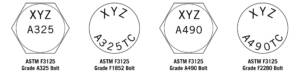
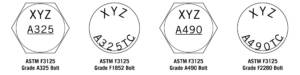
The standard also introduces new marking designations to help identify specific characteristics of the bolts. For instance, bolts with special thread lengths that deviate from the ASME B18.2.6 standard are marked with an “S” designation. This allows designers to specify bolts with alternative thread lengths to meet particular design needs, such as keeping threads out of shear planes in slip-critical connections. Additionally, provisions for full-thread bolts are included, marked with a “T” designation, which allows for greater flexibility in certain applications. However, there are limits on the length of fully threaded bolts to maintain ductility and prevent excessive stretch under tension.
ASTM F3125 also introduced several new features that were not included in any of the previous six standards it replaced. These new features include:
- Inclusion of Twist-off-style / Tension Control (TC) Structural Bolts: ASTM F3125 expanded the scope to include twist-off-type tension control structural bolts, providing specifications for these specialized fasteners used in structural applications.
- Comprehensive Grading System: Unlike the previous standards, ASTM F3125 incorporates a graded system that categorizes fasteners into different grades based on their mechanical properties and performance requirements. This allows for more precise selection of fasteners for specific applications.
- Updated Testing and Quality Control Procedures: ASTM F3125 includes updated testing and quality control procedures to reflect advancements in testing methodologies and industry best practices. These rigorous testing protocols help ensure the reliability and consistency of fasteners.
- Expansion of Covered Materials: ASTM F3125 covers a broader range of materials, including carbon steel and alloy steel, to accommodate various construction requirements and advancements in material technology.
These new features represent advancements in bolting standards, providing a more comprehensive and versatile framework for structural fasteners.
ASTM F3125 Charts
F3125 Bolt Types
| Grade | Min Strength, Tensile | Type | Style |
| A325 | 120 ksi min | 1 or 3 | Heavy Hex Head |
| A325M | 830MPa min | 1 or 3 | Heavy Hex Head |
| F1852 | 120 ksi min | 1 or 3 | Twist-Off/TC |
| A490 | 150 ksi | 1 or 3 | Heavy Hex Head |
| A490M | 1040MPa | 1 or 3 | Heavy Hex Head |
| F2280 | 150 ksi | 1 or 3 | Twist-Off/TC |
|
Type 1 – 120 ksi – carbon, carbon boron, alloy, or alloy boron steel Type 1 – 150 ksi – alloy or alloy boron steel Type 3 – weathering steel |
|||
Chemical Requirements – Type 1
| Heat Analysis | 120 ksi, % | 150 ksi, % |
| Carbon | 0.30 – 0.52 | 0.30 – 0.48* |
| Manganese | 0.60 min | 0.60 min |
| Phosphorus | 0.035 max | 0.035 max |
| Sulfur | 0.040 max | 0.040 max |
| Silicon | 0.15 – 0.30 | – |
| Boron | 0.003 max | 0.003 max |
| Copper | – | – |
| Nickel | – | – |
| Chromium | – | – |
| Molybdenum | – | – |
| *Carbon 0.35-0.53% for 1-1/2” A490/150 ksi bolts | ||
Type 3 bolts can also be produced from a material with a chemical composition that has a corrosion index of 6 or greater, as calculated from the heat analysis and as described in ASTM Guide G101. The corrosion index can be calculated using the predictive method based on the data of Larrabee and Coburn or the predictive method based on the data of Townsend. (See ASTM Guide G101 for methods of estimating the atmospheric corrosion resistance of low alloy steels.)
Chemical Requirements – Type 3
| Heat Analysis | 120 ksi, % Comp A | 120 ksi, % Comp B | 120 ksi, % Index | 150 ksi, % Index |
| Carbon | 0.33 – 0.40 | 0.38 – 0.48 | 0.30 – 0.52 | 0.30 – 0.53 |
| Manganese | 0.90 – 1.20 | 0.70 – 0.90 | 0.60 min | 0.60 min |
| Phosphorus | 0.035 max | 0.035 max | 0.035 max | 0.035 max |
| Sulfur | 0.040 max | 0.040 max | 0.040 max | 0.040 max |
| Silicon | 0.15 – 0.30 | 0.30 – 0.50 | ||
| Copper | 0.25 – 0.45 | 0.20 – 0.40 | 0.20 – 0.60 | 0.20 – 0.60 |
| Nickel | 0.25 – 0.45 | 0.50 – 0.80 | 0.20 min* | 0.20 min* |
| Chromium | 0.45 – 0.65 | 0.50 – 0.80 | 0.20 min | 0.20 min |
| Molybdenum | 0.06 max | 0.10 min* | 0.10 min* | |
|
*Either Nickel or Molybdenum must be present in the amount specified *Corrosion Index based on ASTM Guide G101 |
||||
F3125 Mechanical Properties
| Grade | Tensile, ksi | Yield, ksi min | Elongation, % min | RA, % min |
| 120 ksi (A325/F1852) | 120 min | 92 | 14 | 35 |
| 150 ksi (A490/F2280) | 150-173 | 130 | 14 | 40 |
F3125 Marking Requirements & Matching Components
| 120 ksi, Type 1 | 120 ksi, Type 3 | 150 ksi, Type 1 | 150 ksi, Type 3 | |
| Marking | A325 | A325 | A490 | A490 |
| Nut, Plain | A563 DH | A563 DH3 | A563 DH | A563 DH3 |
| Nut, Coated | A563 DH | A563 DH3 | A563 DH | A563 DH3 |
| Washer | F436-1 | F436-3 | F436-1 | F436-3 |
|
||||
F3125 Permitted Coatings
| Bolt | F2329 Hot Dip Galvanizing | B695 Mechanical Galvanizing | F1136 Zinc/Aluminum (Geomet) | F2833 Zinc/Aluminum |
| A325 | Approved | Class 55 | Grade 3 | Grade 1 |
| F1852 | Not Approved | Class 55 | Not Approved | Not Approved |
| A490 | Not Approved | Not Approved | Grade 3 | Grade 1 |
| F2280 | Not Approved | Not Approved | Not Approved | Not Approved |
|
*Other coatings may be used on 120 ksi/A325 fasteners upon agreement between purchaser and user. Coatings on 150 ksi/A490 fasteners must be qualified by ASTM committee F16. *As of 2020, F1136, F2833 and F3019 have been withdrawn and combined into a new coating standard, F3393. |
||||
F3125 Nut Overtap Allowances
| Size | F2329 and B695, in | F1136 and F2833, in |
| ½-13 | 0.018 | 0.009 |
| 5/8-11 | 0.020 | 0.010 |
| ¾-10 | 0.020 | 0.010 |
| 7/8-9 | 0.022 | 0.011 |
| 1-8 | 0.024 | 0.012 |
| 1-1/8-7 | 0.024 | 0.012 |
| 1-1/4-7 | 0.024 | 0.012 |
| 1-3/8-6 | 0.027 | 0.014 |
| 1-1/2-6 | 0.027 | 0.014 |
|
||
ASTM F3125 Bolting Tools & Methods
Understanding the bolt specification is only part of installing a structural connection correctly. The installation method, equipment, procedure, and verification process all matter. Common installation methods include:
Turn-of-Nut Method
The Turn-of-Nut method involves bringing the connection to snug-tight condition then using a Turn-of-Nut wrench to rotate the nut a specified degree of rotation based on the bolt diameter, grade, and connection requirements.
Calibrated Wrench Method
The calibrated wrench method uses a torque wrench to tighten the connection to a specified torque value. ASTM F3125 provides guidelines for torque installation, including the recommended torque values based on the bolt diameter, grade, and lubrication condition.
Twist-Off Tension Control Bolt Method
TC bolts are installed using a shear wrench that grips the splined end of the bolt while turning the nut. Once the required tension is reached, the spline shears off. The TC bolt method provides a straightforward visual indication ensuring proper installation.
FAQs
What does ASTM F3125 replace?
ASTM F3125 merges six previous standards — A325, A325M, A490, A490M, F1852 and F2280 — into one unified specification for high-strength structural bolts.
What’s the difference between A325 and A490 bolts under F3125?
A325 corresponds to the 120 KSI strength grade, while A490 corresponds to 150 KSI — both are now governed under the single F3125 specification.
Are tension control (TC) bolts covered under ASTM F3125?
Yes. F3125 was the first standard to formally include TC bolts alongside traditional heavy hex bolts.
What’s the difference between Type 1 and Type 3 bolts?
Type 1 bolts are standard carbon or alloy steel with various finish options. Type 3 bolts are made from weathering steel for greater corrosion resistance in outdoor applications.
What installation methods does ASTM F3125 govern?
Turn-of-Nut, torque, and shear installation. Each with its own requirements based on bolt diameter, grade, and lubrication condition.
Do I need different tools for F3125 bolts than older A325/A490 bolts?
No. Since F3125 consolidates those older standards, the same Turn-of-Nut, torque, and shear wrenches used for A325/A490 still apply.