

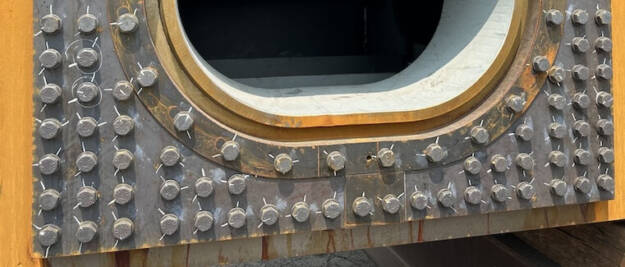
Turn-of-Nut Method is an industry procedure for verifying bolt pretensioning in structural applications. But what exactly is it, and how is it performed correctly in the field?
Key Takeaways
- The Turn-of-Nut method is a rotation-based installation method that achieves the required bolt tension through a specified amount of rotation after snug tightening.
- The required rotation depends on the bolt diameter, length, and connection conditions, so the appropriate RCSC requirements should be referenced before installation.
- Snug tightening must happen before the final rotation. The connection needs to be drawn into firm contact before the wrench can accurately complete the required rotation.
- Matchmarking is essential for installation and inspection, providing a clear visual reference for confirming the required nut rotation.
- Pre-installation verification (PIV) should replicate actual field conditions, including the fasteners, tools, installation method, and testing procedures that will be used on the job.
- Failed PIV tests are often caused by procedure or environmental factors rather than defective bolts, making proper snug tightening, matchmarking, lubrication, storage, and training critical to consistent results.
What is the Turn-of-Nut Method?
The Turn-of-Nut method is a rotation-based installation technique commonly used in bridge construction and structural steel bolting. Rather than relying solely on torque values, this method achieves the required minimum tension by applying a specified amount of relative rotation between the bolt and nut.
This method can be performed using a torque wrench or, more conveniently, with a Turn-of-Nut wrench to rotate the nut to a specified degree depending on the bolt diameter and length.
Turn-of-Nut is governed by the Research Council on Structural Connections (RCSC), Specification for Structural Joints Using High-Strength Bolts, and is frequently used in slip-critical and fully tensioned connections. When properly performed, the controlled rotation:
- Increases friction between steel connections
- Reduces structural deflections
- Prevents loosening under impact loads or vibrations
- Strengthens connections in harsh environments
How to Perform the Turn-of-Nut Method
When performing pre-installation verifications (PIV), ensure every bolt assembly is treated consistently. All variables should match the conditions that will be used during actual installation, including fastener condition (as supplied or lubricated, if permitted), tool selection, installation method and testing procedures.
Turn-of-Nut Method Steps:
- Determine Required Rotation
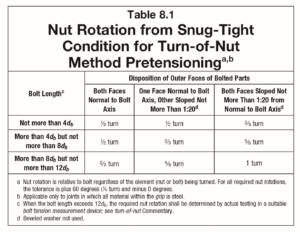
Identity the ratio of bolt length and diameter as well as the slope disposition of the outer steel plies. Refer to the RCSC Table 8.1 (pg.16.2-63) below to determine proper required rotation.
- Insert Bolting Assembly into Calibrator
Using a bolt tension measuring device, insert bolt, washer, and nut, as well as any DTIs. Confirm the device’s calibration certificate is up to date before proceeding. - Snug Tighten the Connection
Snug tight is required prior to final rotation and is achieved with a few impacts of an impact wrench or the full effort of an ironworker using a spud wrench. Refer to RCSC Section 8.1 (pg.16.2-60) on snug-tightened joints. - Matchmarking
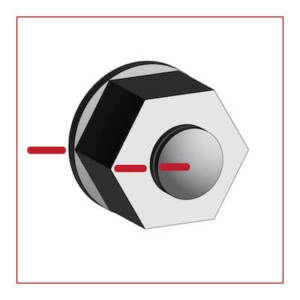
Using a marker or wax pencil, draw a line from the center of the bolt point across the nut and onto the steel. This indicates the starting position for inspection and verification. Click to watch.

- Set Angle Dial on TN Wrench
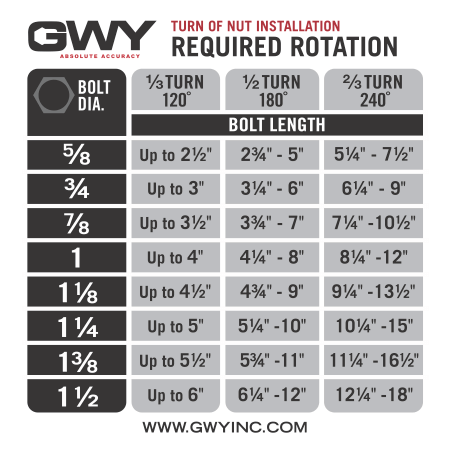
If you’re using a TONE Turn-of-Nut Wrench for the final turn, set the dial to the required degree according to the chart below. This chart is also included with every tool case for quick reference.

- Perform Final Rotation
Using the tool, pull the trigger and rotate the nut to the specified degree. The tools will stop on its own once the rotation is complete. - Confirm Minimum Bolt Pretension
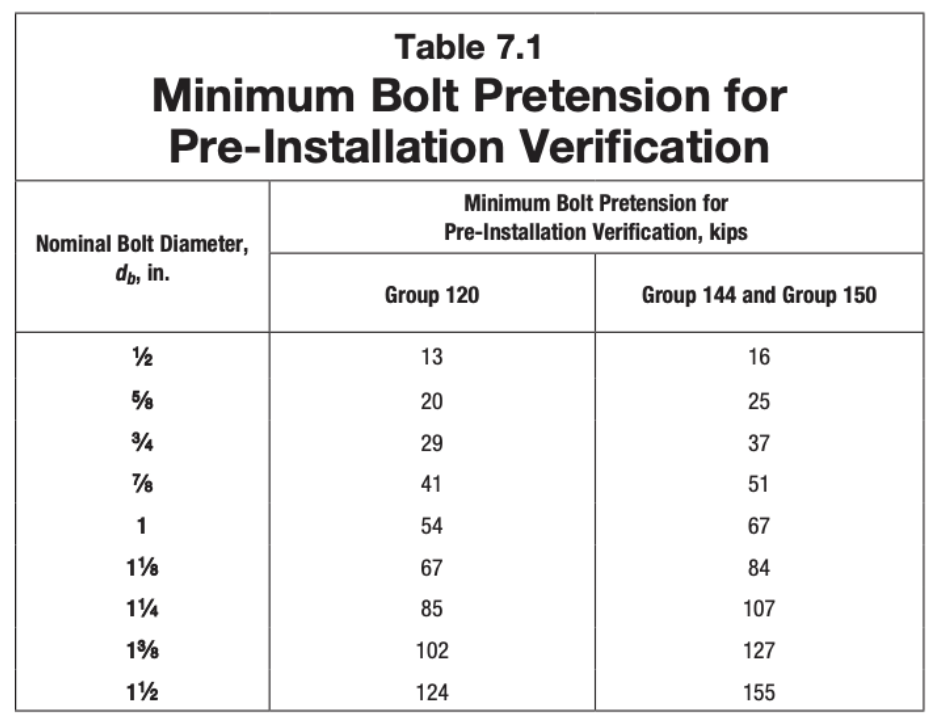
After rotation, verify that the nut achieved the required rotation and confirm the bolt tension calibrator’s gauge indicates at least the minimum required tension or higher (never less) according to RCSC Table 7.1 (pg.16.2-54) for the bolt diameter being tested.
 Source: Specification for Structural Joints Using High-Strength Bolts, Research Council on Structural Connections (RCSC), June 2020
- For example, a 1″ diameter bolt under 4″ in length requires 120° (1/3 turn) beyond snug tight, as seen below, and must meet a minimum of 54 kips, or 54,000 lbf.
 Note: For the most accurate results, make sure you matchmark the bolt, nut and steel prior to applying the Turn-of-Nut Method.
- For example, a 1″ diameter bolt under 4″ in length requires 120° (1/3 turn) beyond snug tight, as seen below, and must meet a minimum of 54 kips, or 54,000 lbf.
 Source:
 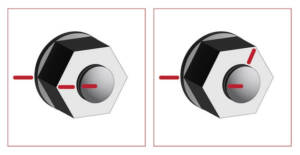 Note: For the most accurate results, make sure you matchmark the bolt, nut and steel prior to applying the Turn-of-Nut Method.
Pre-Installation Verification Best Practices
We recommend that pre-installation verification (PIV) be conducted onsite using the same tools that will be used during installation. This helps identify potential issues or incompatibility between tools, fasteners, and installers before any actual work takes place.
The Turn-of-Nut method must be the final step in the installation process for each bolt assembly. The final pretensioning is done only after all connections have been snug tightened or drawn into firm contact. TN tools will not properly count rotations unless the assembly is snug tight.
To ensure accurate results, bolt tension calibrators and Turn-of-Nut wrenches should be regularly serviced by a qualified provider. We offer these services for all products we supply.
How to Inspect Turn-of-Nut Connections
Inspection relies primarily on the matchmarks applied prior to rotation.
Inspectors verify that the:
- Nut rotated the required amount relative to the starting position.
- Rotation aligns with the required degrees specified by RCSC Table 7.1.
In most jurisdictions, inspectors are not required to independently verify snug tightening.
Considerations When Performing PIV
Short Bolts:
Short bolts can present challenges during pre-installation verification. If a bolt is too short to fit into a bolt tension measuring device/calibrator:
- Install the bolting assembly in a steel plate with the proper size hole
- Apply the required rotation for the bolt diameter
- Remove the assembly and confirm that no stripping has occurred
In this case, verification of achieved pretension per RCSC Table 7.1 is not required. The test confirms that the assembly can sustain a strain without failure to produce the minimum required pretension.
Lubrication & Galvanized Bolts:
- Lubricated or galvanized bolts require less torque and can be easier to snug tighten, increasing the risk of over-tightening before applying Turn-of-Nut, potentially causing bolt fracture.
- Insufficient lubrication can cause seizing or rotation failure before reaching required pretension.
Proper training, protocol, and tools are essential for performing accurate PIV results. Contact us if you have any concerns.
Causes of Failed PIV Tests
When a pre-installation verification (PIV) test fails, it’s easy to assume the bolt is defective. In reality, bolts are rarely the root cause. Most failed PIV tests are the result of environmental factors or missed procedural steps.
Common Causes of Failed PIV Tests
- Storage & Environmental Conditions
Temperature, debris, and moisture can all affect installation performance and PIV results. - Missing or Incorrect Matchmarking
Without proper matchmarks, inspectors cannot verify rotation. Incorrectly placed or unclear markings can also lead to the false assumption that rotation was inaccurate. - Failure to Snug Tight Properly
Snug tightening is not optional and is required by the AISC/RCSC specifications. If the assembly is not drawn into firm contact before final rotation:- Tool may not count properly
- Rotation will not be met
- Required tension may not be achieved
- Inconsistent or Improper Lubrication
Lack of lubrication can significantly affect rotation and tension results. Watch video below:
FAQs
What is the Turn-of-Nut method used for?
Turn-of-Nut is an installation method used in structural bolting, often in bridge construction. It is the most accurate way of tightening bolts to a specified rotation and achieving the minimum required tension.
Do I need a special wrench for the Turn-of-Nut method?
It can be performed with a torque wrench, but a dedicated Turn-of-Nut wrench makes the process faster and more consistent by automatically stopping at the required rotation.
What is matchmarking and why is it important?
Matchmarking gives the bolting assembly a visual for the starting position before final rotation. It’s the only way inspectors can verify the correct amount of rotation was achieved.
Does the Turn-of-Nut method require snug tightening first?
Yes, the assembly must be snug tight before final rotation, or the required tension might not be achieved.
What causes a Turn-of-Nut installation to fail inspection?
Most failures come from missing matchmarks, lack of lubrication, or skipping the snug-tight step.
Can lubrication affect Turn-of-Nut results?
Yes, lubricated or galvanized bolts require less effort to snug tighten, as well as when pretensioning.